Have you ever felt lost reading the Bible, wishing someone could just show you how everyone connects? That’s where a biblical family tree comes in, like a warm hand guiding you through. It shows who came from who, heart by heart, name by name. From Adam and Eve all the way down to Jesus, a biblical family tree tells one big beautiful story. No more flipping pages, no more forgetting who’s who. Just look at the biblical family tree, and suddenly, it clicks. It feels less like a book now, and more like a family you belong to.
Without one, the Bible can feel like a maze of names and faces. But a biblical family tree changes everything, it turns confusion into connection. You start to feel how each person matters, how every life fits into something bigger. Kings, prophets, mothers, and dreamers all live inside the biblical family tree. Slowly, you notice threads you never saw before, love, faith, and legacy tying it all together. Whether you’re reading for study or for your soul, a biblical family tree makes the stories breathe again. It’s not just names anymore, it’s people you start to care about.
What Is a Biblical Family Tree?
A biblical family tree is simply a map of who belongs to who in Scripture. It traces parents, children, and grandchildren across generations, showing how one family grew into a whole nation, and eventually, into the story of Jesus. Think of it like a giant family reunion chart, but one that spans thousands of years.
You’ll find these genealogies scattered throughout the Bible, in books like Genesis, Chronicles, Ruth, Matthew, and Luke. Some lists are short, just a few names. Others stretch on for pages. But every biblical family tree serves the same purpose: it connects the dots between real people and God’s bigger plan.
Understanding a biblical family tree helps you see the Bible less like a collection of separate stories and more like one continuous family history. It’s history with heart.
Why Are Family Trees Important in the Bible?
At first glance, long lists of names can feel easy to skip over. But a biblical family tree carries real weight. In ancient times, your family line proved who you were. It showed your tribe, your inheritance, and your place in God’s promises.
Family trees also prove that God keeps His word. He promised Abraham a family as countless as the stars (Genesis 15:5), and the genealogies show that promise unfolding, generation after generation. Every name is a small piece of evidence that God was faithful, even when it took centuries to see the full picture.
A few reasons these lists matter so much:
- They confirm royal and priestly lines, like David’s kingship and Levi’s priesthood
- They connect Old Testament promises to New Testament fulfillment
- They remind us that ordinary people were part of an extraordinary story
The Biblical Family Tree From Adam to Noah
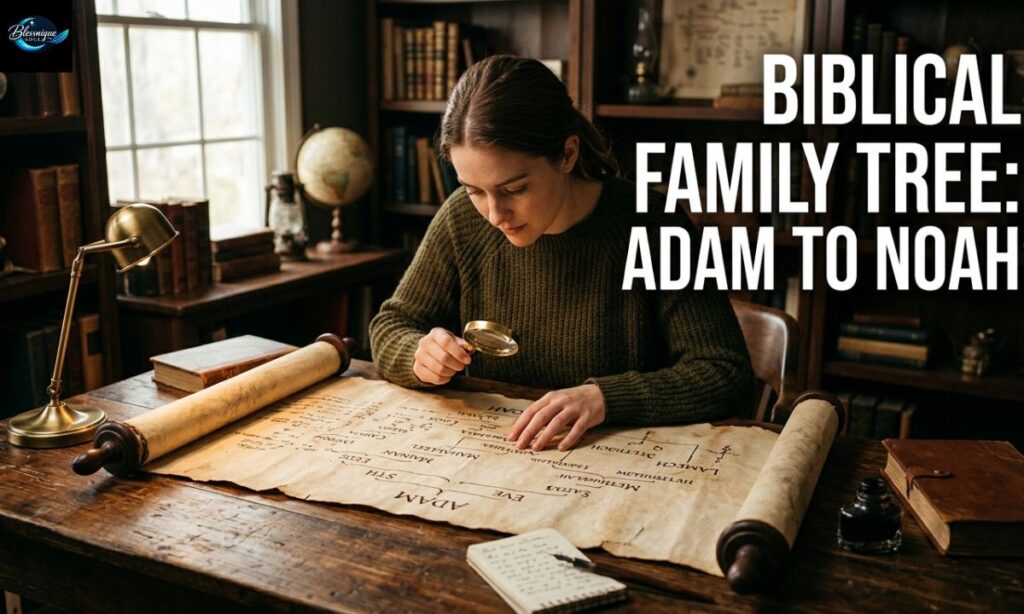
The Bible’s story of humanity begins with Adam, the first man, and it’s Genesis 5 that gives us the first real biblical family tree. This chapter lists ten generations, starting with Adam and ending with Noah.
Adam had his son Seth, and from there the line continues through Enosh, Kenan, Mahalalel, Jared, Enoch, Methuselah, Lamech, and finally Noah. Each name comes with an age, showing just how long people lived in those early days. Methuselah, for example, lived 969 years, the oldest age recorded in Scripture (Genesis 5:27).
This part of the biblical family tree isn’t just about names and numbers. It shows humanity multiplying and spreading out, while God’s plan quietly moves forward in the background, waiting for the right moment to act through Noah.
Noah’s Family Tree and His Descendants
Noah’s family tree picks up right after the flood, and it’s one of the most important genealogies in the whole Bible. Noah had three sons: Shem, Ham, and Japheth. Genesis 10, often called the “Table of Nations,” traces how their descendants spread out and formed different nations and peoples across the earth.
Japheth’s descendants generally moved north and west, settling regions later linked to Europe and parts of Asia. Ham’s line moved into Africa and parts of the Middle East. Shem’s descendants are especially significant, because this line eventually leads to Abraham.
This part of the biblical family tree shows the whole earth being repopulated after the flood, while quietly setting the stage for the next major figure in God’s story.
Abraham’s Family Tree and His Descendants
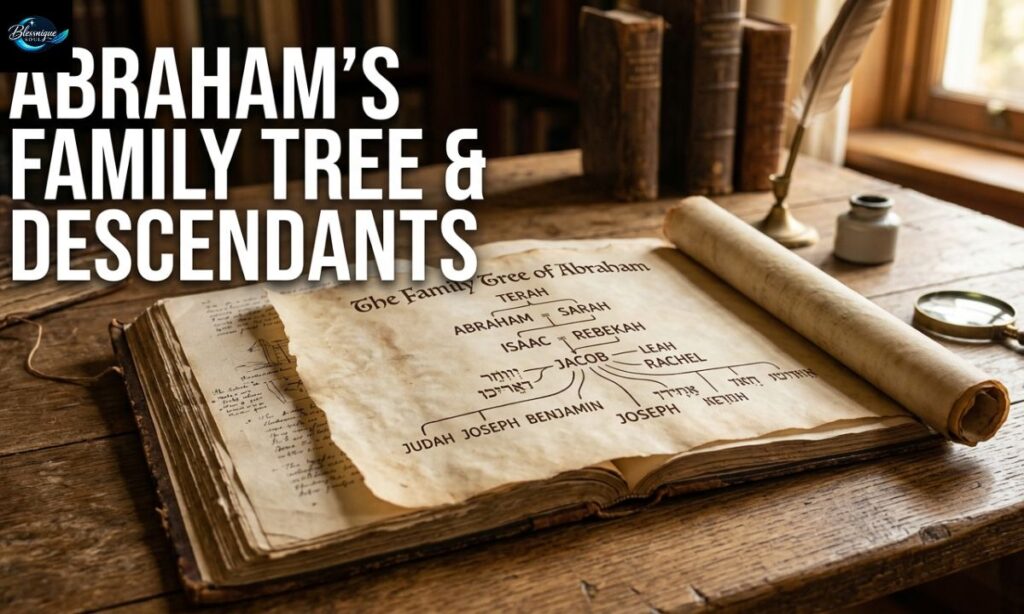
Abraham’s family tree is where things really start to take shape. Abraham, originally called Abram, came from Shem’s line through his father Terah (Genesis 11:26-27). God called Abraham to leave his home and promised to make him into a great nation (Genesis 12:2).
Abraham had two key sons. Ishmael, born through Hagar, became the father of twelve tribal rulers and is seen as an ancestor of many Arab peoples. Isaac, born through Sarah in their old age, was the son of promise, the one through whom God’s covenant would continue.
This branch of the biblical family tree marks a turning point. From here on, the story narrows in on one specific family line, chosen to carry God’s promises forward to the rest of the world.
Isaac and Jacob’s Biblical Family Tree
Isaac married Rebekah, and together they had twin sons: Esau and Jacob (Genesis 25:24-26). Esau, the firstborn, later sold his birthright to Jacob for a bowl of stew, a decision that changed the course of the family line completely.
Jacob became the one through whom God’s covenant continued. Later, God renamed him Israel (Genesis 32:28), and that name would go on to define an entire nation. Jacob married Leah and Rachel, and also had children through their servants Bilhah and Zilpah.
This part of the biblical family tree is a turning point most readers find fascinating, because Jacob’s twelve sons become the foundation for the twelve tribes of Israel.
Jacob’s Twelve Sons and the Tribes of Israel
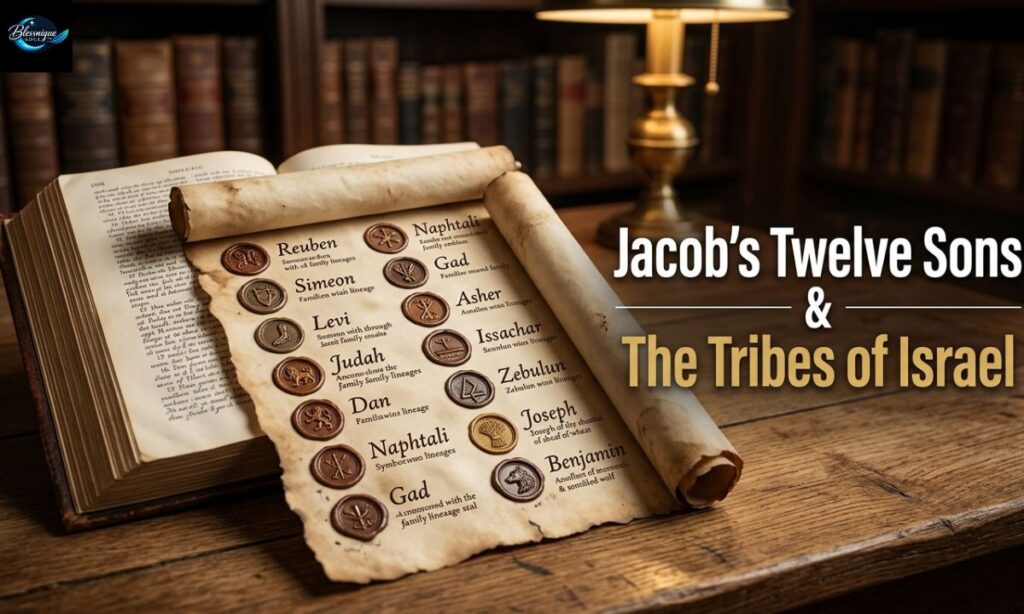
Jacob’s twelve sons became the heads of the twelve tribes of Israel, one of the most well-known parts of any biblical family tree. Their names were Reuben, Simeon, Levi, Judah, Dan, Naphtali, Gad, Asher, Issachar, Zebulun, Joseph, and Benjamin (Genesis 35:22-26).
Each tribe grew into its own community, with its own land, identity, and role. Levi’s descendants became priests, serving in the tabernacle and later the temple. Judah’s line grew especially significant, since it eventually leads to King David, and later, to Jesus.
Here’s a simple way to remember why this matters:
- Levi: the priestly tribe, set apart for temple service
- Judah: the royal tribe, leading to David and Christ
- Joseph: split into two tribes through his sons, Ephraim and Manasseh
This section of the biblical family tree shows one family growing into an entire nation, just as God had promised Abraham generations earlier.
David’s Family Tree and the Royal Line
David’s family tree connects back to Judah through a line that includes Boaz and Ruth, whose story is told in the book of Ruth. Their son Obed was the grandfather of Jesse, and Jesse was David’s father (Ruth 4:17-22).
David, once a shepherd boy, became Israel’s greatest king. God made a covenant with him, promising that his throne would last forever (2 Samuel 7:16). That promise becomes one of the most important threads running through the rest of the biblical family tree.
David had many sons, but Solomon, born through Bathsheba, became his successor and built the first temple. From here, the royal line continues through Judah’s kings, all the way up to the time just before Jesus’ birth.
The Biblical Family Tree of Jesus Christ
The biblical family tree of Jesus Christ is recorded in two places: Matthew 1 and Luke 3. Matthew traces Jesus’ line through Joseph, starting with Abraham and moving forward through David and the kings of Judah. Luke traces the line through Mary, going all the way back to Adam.
Both genealogies confirm something powerful: Jesus fulfills the promises made to Abraham and David. He’s not a stranger stepping into history. He’s part of the family, born through the very line God had been shaping for generations.
What makes this genealogy so moving is who’s included. Names like Tamar, Rahab, Ruth, and Bathsheba, women with complicated stories, are woven into Jesus’ family tree. It’s a beautiful reminder that God works through real, imperfect people to bring about His perfect plan.
Adam to Jesus: A Biblical Genealogy Timeline
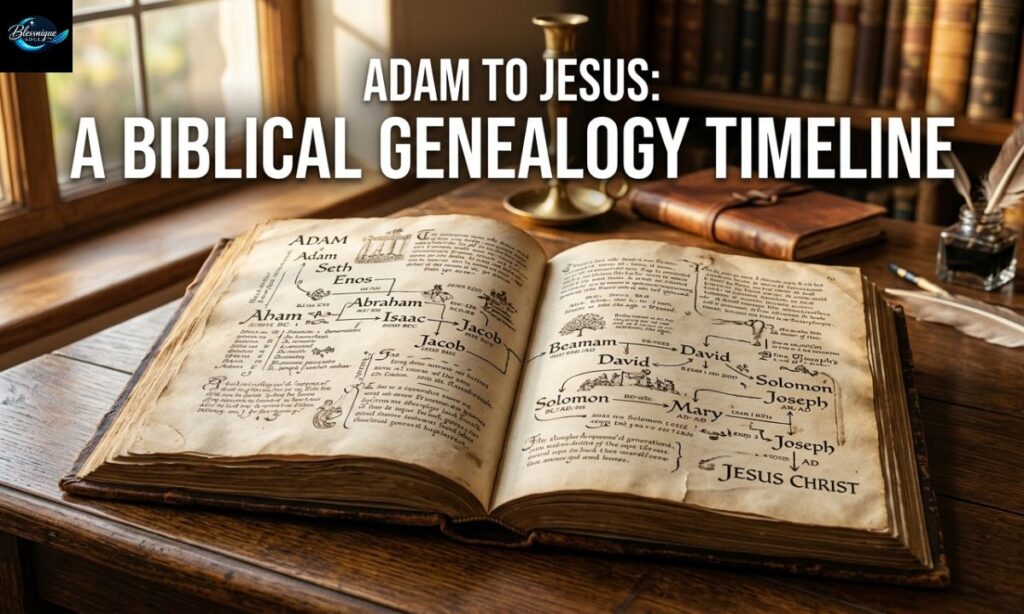
Looking at the biblical family tree from Adam all the way to Jesus gives you a sense of just how long and patient God’s plan really was. It stretches across thousands of years and dozens of generations.
Here’s a simplified path through the major stops along the way:
- Adam to Noah: the first ten generations of humanity
- Noah to Abraham: the nations spread out, then narrow to one family
- Abraham to Jacob: the covenant passes through Isaac and Jacob
- Jacob to David: the twelve tribes form, and the royal line begins
- David to Jesus: the kingly line leads to the promised Messiah
Seeing it laid out this way helps the Bible feel less like separate stories and more like one long, connected journey toward Christ.
Important Families and Genealogies in the Bible
Beyond the main line from Adam to Jesus, the Bible includes several other genealogies worth knowing. The book of 1 Chronicles opens with chapters of names, tracing tribal lines and family divisions in careful detail.
Ruth’s family line is especially touching, since a Moabite widow ends up becoming David’s great-grandmother. The priestly line of Aaron and Levi is tracked closely too, since it determined who could serve in the tabernacle and temple.
Even smaller genealogies, like those of the judges or the returning exiles in Ezra and Nehemiah, show how seriously ancient Israel took family identity. Every biblical family tree, big or small, tells its own piece of the larger story.
What Can We Learn From Biblical Family Trees?
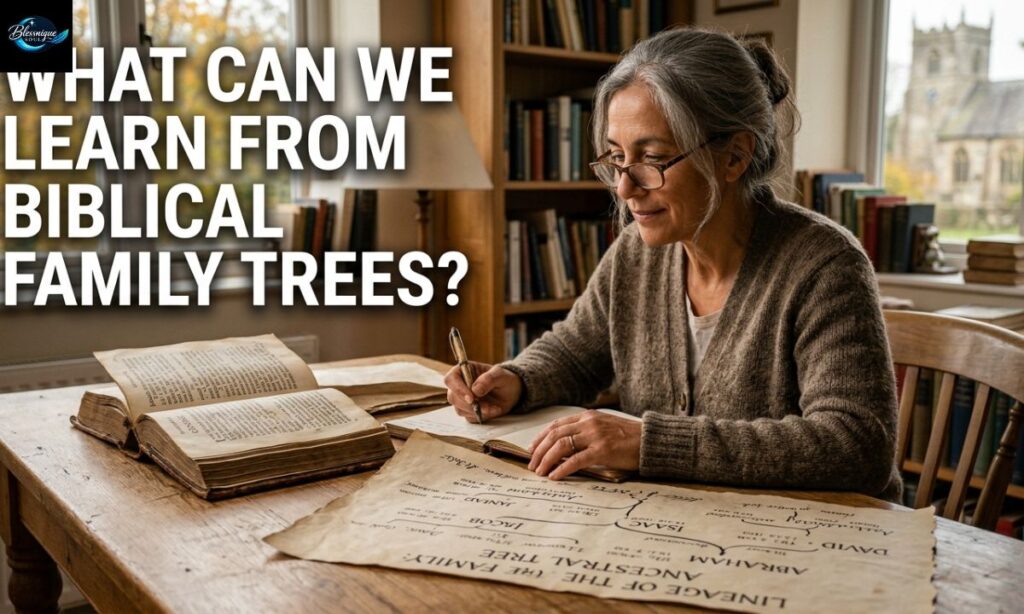
Studying a biblical family tree teaches us more than just names and dates. It shows that God works slowly, patiently, and faithfully across generations, even when it doesn’t look like much is happening at the time.
It also shows that God uses ordinary, flawed people, liars, foreigners, shepherds, and sinners, to accomplish extraordinary things. Nobody in these genealogies was perfect, yet each one played a part in God’s unfolding story.
Most of all, a biblical family tree reminds us that every person matters. Just like each name in Scripture had a place and a purpose, so do we. It’s a quiet but powerful encouragement that we’re all part of a story much bigger than ourselves.
Frequently Asked Questions
What is the family tree in the Bible?
The biblical family tree traces important generations, from Adam through Abraham, David, and eventually Jesus Christ.
Who’s DNA did Jesus have?
The biblical family tree shows Jesus descended from David through His human lineage, while Christians believe He is divine.
What are the 42 generations in the Bible?
The biblical family tree in Matthew lists 42 generations from Abraham to Jesus, divided into three groups.
Which generation will not pass away?
The biblical family tree does not identify one generation that will never pass away; Jesus teaches about His words.
What is Jesus’ family tree called?
The biblical family tree of Jesus is called His genealogy, recorded notably in Matthew and Luke.
Final Thought
A biblical family tree is more than just names on a page. It’s a beautiful reminder of how God works through real people, generation after generation. From Adam to Jesus, every biblical family tree shows patience, love, and faithfulness woven together. It helps you see the Bible as one big story, not scattered pieces. And once you understand a biblical family tree, everything else starts to make sense too.
So next time you feel lost in Scripture, come back to the biblical family tree. Let it guide you, name by name, story by story. It connects the past to the present, and reminds you that you’re part of something bigger. A biblical family tree isn’t just history, it’s hope you can hold onto.